
Differences between Yonex badminton rackets
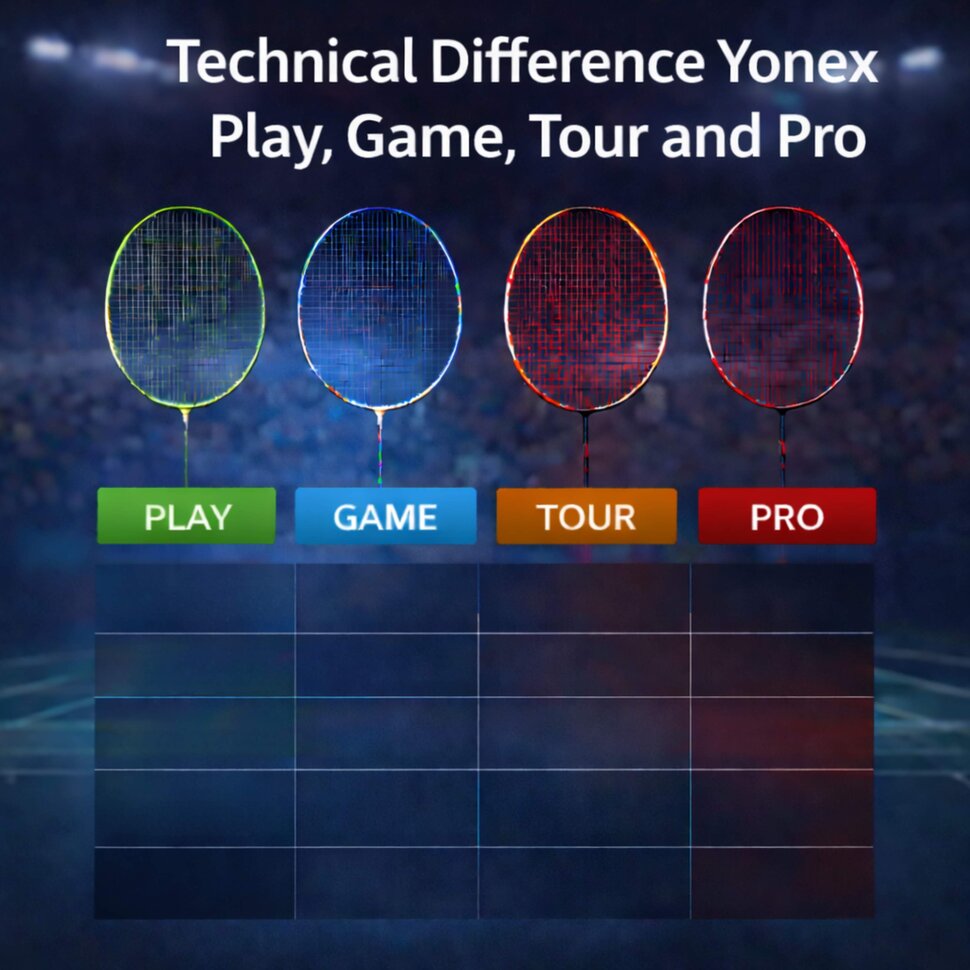
Yonex Play vs Game vs Tour vs Pro: The Technical Differences Explained
What is the technical difference between Yonex Play, Game, Tour and Pro?
Although these models belong to the same Yonex badminton racket series, they differ fundamentally in:
- Shaft stiffness
- Carbon quality
- Frame construction
- Energy transfer
- Torsional stability
- Manufacturing consistency
In this blog, we explain the difference in technical and concrete terms. Not sure which level suits your game? Then first read our complete selection guide on which Yonex racket suits your level.
Shaft Stiffness (Flexibility)
The biggest technical difference lies in the shaft.
|
Level |
Shaft |
|
Play |
Flexible |
|
Game |
Medium |
|
Tour |
Medium-stiff |
|
Pro |
Stiff / Extra stiff |
What does this mean in practice?
Flexible shaft (Play)
- Bends more during impact
- Helps players with lower swing speed
- More forgiving
- Slower rebound timing
Are you just starting out and want to know which model best suits your beginner level? Then check out our beginner's guide to the best Yonex badminton racket for beginners.
Stiff shaft (Pro)
- Less shaft flex
- Faster recovery
- More direct feedback
- Requires higher swing speed
For advanced players, Play can feel “too slow” because the shaft is still recovering while the shot is already completed.

Energy Transfer and Timing
The stiffer the badminton racket, the more direct the energy transfer.
Play badminton racket
- More energy absorption
- Comfortable, but less explosive
Game badminton racket
- Balanced energy transfer
- Good mix of comfort and responsiveness
Tour badminton racket
- Faster energy return
- More power at the same swing speed
Pro badminton racket
- Maximum energy transfer
- Precise timing required
Players with higher swing speed benefit much more from Tour or Pro than from Play.
Why is an expensive badminton racket not always better? Read about it in our blog.
Frame Stability and Torsional Control
During powerful smashes, the frame slightly twists (torsion). The higher the carbon quality, the less torsion occurs.
Play badminton racket
- More frame deformation
- Larger sweet spot, but less structural stability
Game badminton racket
- Improved torsional stability
Tour badminton racket
- High torsional stability
- Better control on off-center hits
Pro badminton racket
- Minimal torsion
- Maximum precision at impact
For competitive players, this becomes crucial during fast rallies.
Balance Point and Playing Dynamics
Balance differs per model, but general tendencies are:
- Play → often even balance
- Game → more variation
- Tour → competition-focused balance setups
- Pro → optimized for maximum power or control
Important:
A stiff shaft combined with a very head-heavy balance requires strong technique and high swing speed.
A flexible shaft combined with head-heavy balance can feel unstable.
String Tension and String Choice
One often underestimated factor is string tension.
Pro rackets perform best when combined with:
- Thinner strings
- Higher tension (approximately 11–12 kg / 24–28 lbs and above)
At lower tension, a Pro racket may actually feel less direct than a tightly strung Tour model.
In many cases, this delivers better performance:
- Game or Tour strung at 12 kg
- Regular restringing
Rather than:
- A Pro racket at low tension
- Only restringing 2–3 times per year
The strings are the first point of contact with the shuttle. Often, you gain more performance here than from upgrading the frame alone.
Read our blog to find out when it's time to upgrade your badminton racket and learn more about when it's best to switch.
Manufacturing Consistency and Quality Control
A subtle but important difference lies in production tolerances.
Play models are more mass-produced. For recreational use, this is perfectly fine.
Game and higher levels typically offer:
- Tighter weight tolerances
- More consistent balance
- Greater similarity between multiple identical rackets
For competitive players using 2–3 identical rackets, this consistency is essential.
Technical Comparison Overview
|
Feature |
Play |
Game |
Tour |
Pro |
|
Shaft |
Flexible |
Medium |
Medium-stiff |
Stiff |
|
Energy Transfer |
Comfort-oriented |
Balanced |
Direct |
Maximum |
|
Torsional Stability |
Basic |
Good |
High |
Very high |
|
Sweet Spot |
Large |
Medium |
Medium |
Smaller but precise |
|
Recommended Tension |
8–10 kg |
9–12 kg |
10–13 kg |
11+ kg |
When is each level technically appropriate?
Play badminton racket
- Lower swing speed
- Technique still developing
- Comfort-focused
Game badminton racket
- Greater stability
- Suitable for all-round competitive play
Tour badminton racket
- Competition-oriented
- Higher string tension
- More power without extreme stiffness
Pro badminton racket
- High performance level
- High swing speed
- Maximum control
Conclusion
The difference between Yonex Play, Game, Tour and Pro is not just about price. It comes down to:
- Shaft stiffness
- Energy transfer
- Frame stability
- String interaction
- Production consistency
For many players, the optimal balance lies in Game or Tour. Pro only reaches its full potential when swing speed, technique and string tension are aligned.
Not sure which Yonex racket suits you best? Let our specialists advise you online or in our badminton shop and choose a model that matches your level and ambitions.
Leave a comment
Recent articles
View all
How Is a Nylon Shuttle Made?

Team Dunlop World Top 25 – Womens Squash Players & Their Rackets
They all rely on Dunlop for speed, precision and finesse. Find your own winning ra...

Team Dunlop – World Top 25 Mens Squash Players
Each model delivers the perfect mix...